


OTHER SPECIES
Besides the mentioned species you will be able to fish other ones like Snappers, Jacks, Snooks Barracudas, Needlefish or the combative and voracious Lemons.
Jack Crevalle and Horse Eye
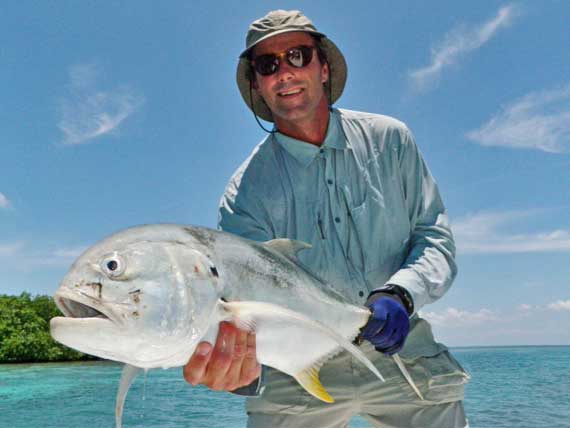
Jacks are wonderful game fish, and are very abundant in the JDR. It is common to see a school of big jacks patrolling the flats, eating everything in sight. Many of these fish are in the fifteen to twenty pound class with some right up to the thirty pound mark. They look somewhat like the permit, being in the same family, but Jacks are one of the most aggressive feeders on the flats and very easy to catch in relation to permit. As a bonus, the Horse Eye jacks make wonderful sashimi back on the boat before dinner.
Snook
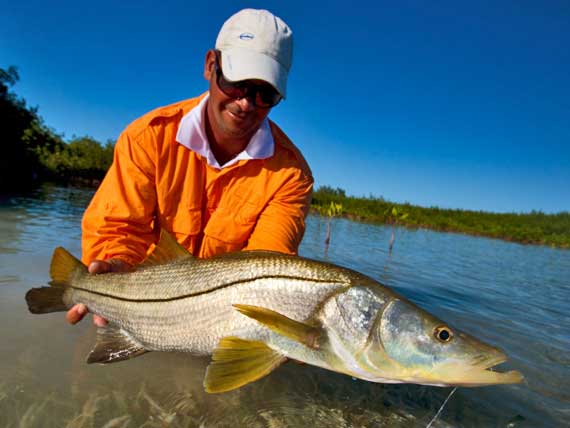
A snook creates incredible fighting power with a wide swooping tail which it will use to try and return deep into the mangroves when it is hooked. An angler has to fight tooth and nail to keep one of these warriors from cutting itself free, one way or the other. Therefore, we power up with heavy leaders, large arbor reels, and nine and ten weight rods in order to generate enough force to give the angler an advantage in the fighting arena. Nevertheless, they are full of stamina and grit, fighting 'til the very end.
In the winter, snook flood the backwaters and offshore reefs, seeking creature comforts while continuing their terror tactics on just about any fish or crustacean that will fit within their maw. When a severe cold front pushes the freezing mark, they become lethargic zombies--yellow-and-white submarines listing on their sides. On the warmer days, snook move from the deep water to the nearby flats. Many times, it’s the tiny bay anchovy that suffers their ravenous wrath a hundredfold. As spring approaches, their thoughts turn to food, then love, like an awakening bear fresh from winter slumber. They stake out the channels and cuts through the flats, popping pinfish and sand perch. The fish feed voraciously, building up their fat supplies for the summer, when they’ll mass in huge schools at inlets, passes and along the beach for a warm-water “Love Connection.”
Mutton Snappers
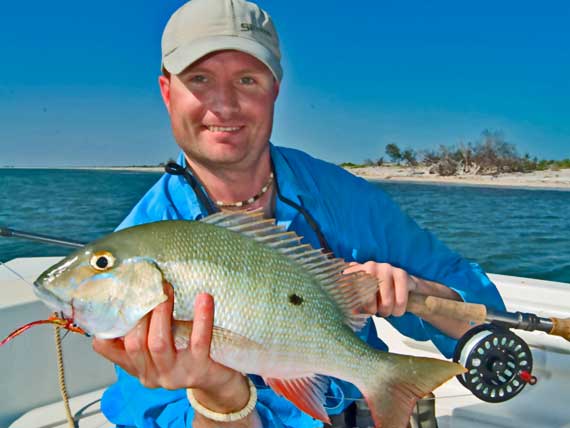
Mutton Snappers are everywhere in the JDR, and plenty are found and caught on the flats - a real rarity. This is perhaps the best (and only) place in the world where you can expect to catch mutton snappers on the flats. They are high powered fish that will pull with dogged determination, especially when the safety of the mangrove roots is within sight. Mutton snappers are extremely wary when out on the flats, but if you can get the right cast in there without spooking them, they are suckers for taking a fly. Most muttons caught on a fly run between three and eight pounds, but fish up to fifteen pounds are a distinct possibility.
Other Fishes
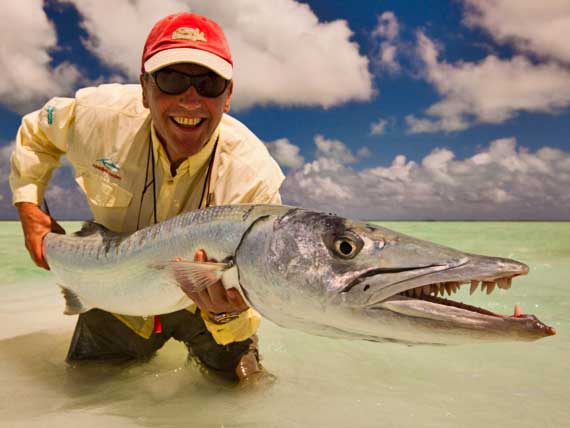
Anglers that want to try fly fishing off the reef will find it possible to encounter a variety of hard fighting species of fish. Various snappers including the huge Cubera Snapper are present as well as groupers, jacks, kingfish, albacore, wahoo, and bonito and big cudas. One group of visiting anglers caught twenty five different species of fish off the reef-in one day!